
LGP#03
Monique, Mon Ami

Jumping right back into the world of Gonzague from Le Garçon Perdu (previous instalments to be found here and here for context), this article covers the central, slower song of the show, ‘Monique, Mon Ami’. Expect narrative twists and thoughts on friendship. Let’s go.
Analysis
Flanked by more upbeat songs, this number covers an important relationship that we have known about since the top of the show, that being the relationship between our boy Gonzague and his only friend Monique. Monique is never seen nor heard from for the entire show, but she is talked about, presented through the eyes of Gonzague.
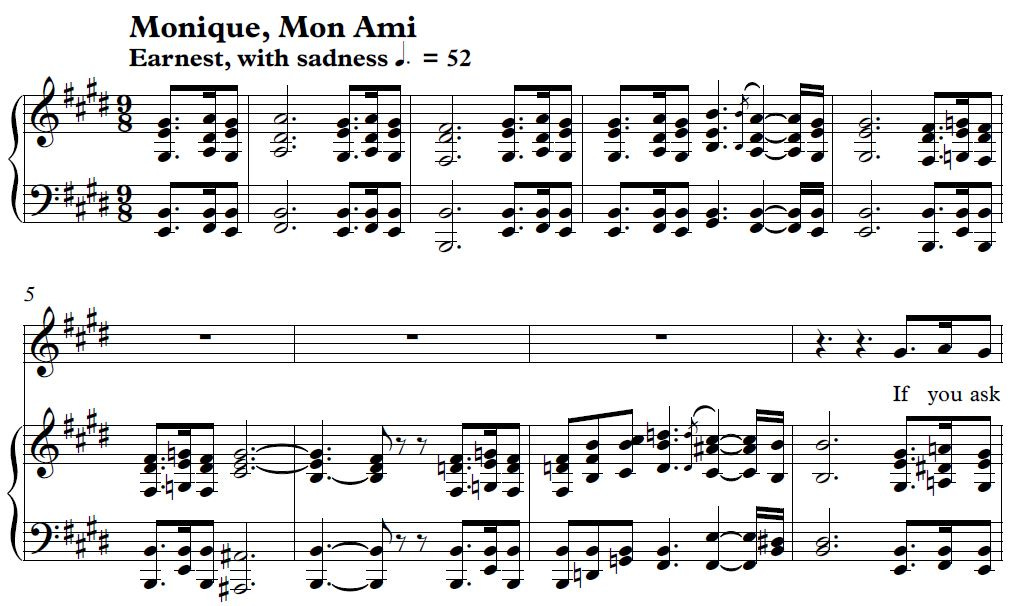
The song follows a simple binary form structure (ABA'B'A'', to be exact), where the A sections (in E major) generally serve to praise Monique, as in “If you ask me / She’ll always be / Wonderful, thoughtful, and wise / That’s Monique”, while the B sections (in D minor) are more anxious and suspenseful, as in “And what am I to do when it’s tough / When le monde is mean and rough / Without her / I’m full of dread”
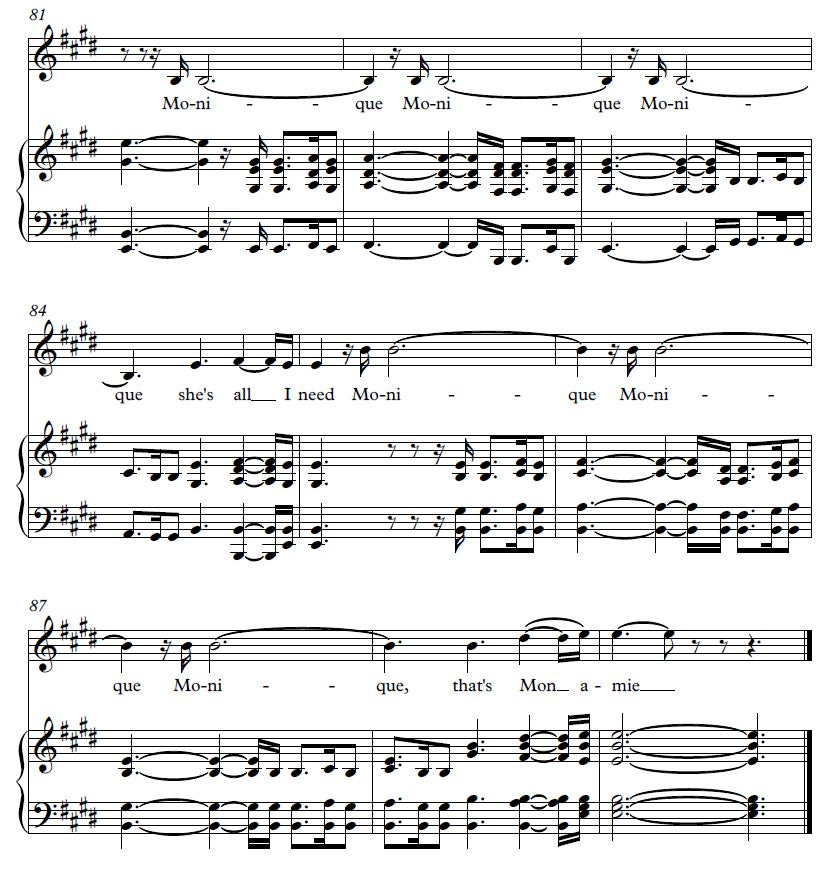
Between these two alternating sections, we get to understand a few key things about how Gonzague views his one friendship. Firstly, that he is extremely dependent, constantly referring to Monique as his advisory care-giver. Secondly, that he thinks very highly of her, e.g. “Gorgeous, amazing, and bright” and “My féerique, my unique, that’s my Monique”. Thirdly, that Gonzague is convinced that she is all he needs in terms of companion and confidant, “Monique, Monique, Monique / She’s all I need”.
But as well as communicating that, this song contains an important crux.
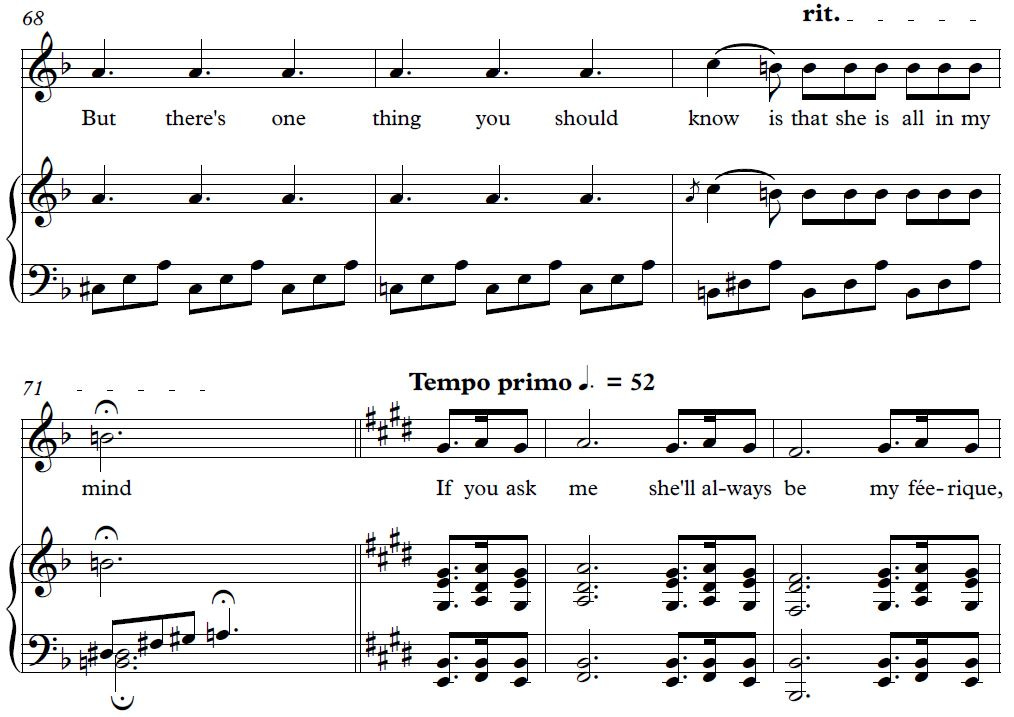
“But there’s one thing you should know / Is that she is all in my mind”
And there we go. Monique isn’t real. She is an imaginary friend, fabricated in order for Gonzague to simply get by and cope. Not only does this reinforce Gonzague’s loneliness, but the audience can now retrospectively realise that Monique’s advice to Gonzague is his own advice to himself. She is his subconscious.
So if we briefly revisit the very top of the show, where we heard Gonzague say to the audience, “My friend Monique told me I need to start talking to more people, that I need more friends”, we now realise that this need, and many more since, are desires that are suppressed by Gonzague, but are nevertheless his.
This act alone dramatically shifts how we now understand Gonzague’s objectives going forward.
So, there’s no real secret with this - the music for Monique, Mon Ami is entirely based on the 2nd of Schubert’s Six Moments Musicaux. This Andantino (originally in A♭ major and for solo piano solo - I’ve taken it down to E and added voice!) seemed too good of a fit when I was contemplating how to communicate the two-pronged message of the show’s 2nd song. Listening to the Schubert, I found myself singing along to the melody with a few lines of draft text, such as “If you ask me, she’ll always be” and the titular “Monique, Mon Ami”, and found it clicking instantly.
Monique, Mon Ami is not an exact bar-by-bar replication of the Schubert - there are a few cuts - but the piano material and the melody all derive from it. The lyrics were my addition, however. Thankfully, not the toughest song to set lyrics to (Cheers, Franz).
Another poignant reason for choosing the Andantino from Schubert’s Six Moments Musicaux as a musical basis is that it’s heavily used in the musical score to the first French film I ever watched, Au revoir les enfants (1987), a film that also discusses themes of friendship, albeit in a very different context.
Psst..
The name Monique was also heavily mentioned in that video of “Worst French Given Names According to Parisians” but the true reason I chose the name Monique is because the meaning of the name Monique is ‘advisor’. It also enjoys other relevant connotations, such as ‘wise’ and ‘single’.
I particularly liked this idea of Gonzague concocting a whole imaginary persona in his head for him to cope with the effects of growing up clearly different. His way of making sense in a world that mistreats him is to frame his desires through the lens of a fabricated friendship. My desire here was to reinforce the image of the outsider and, in some way, nod towards the common experience of queer people choosing their family.
#ChaseTheRedRabbit